Building a messaging framework from scratch
A fleet management company with leads that weren't converting, and messaging that could have belonged to any of its competitors. I led the workshop that gave them a differentiated voice — and 300+ lines of copy to say it with.
The situation
Veturilo had just been acquired, and its new owner had a hunch about why growth had stalled: the messaging wasn't differentiated from every other fleet management tool on the market. I put together and led a workshop for the team to build a pack of refreshed, reusable messaging — with two goals: lift the number of visitors who actually started sign-up, and leave a non-English-native team with ready-to-use material for cross-functional collateral, not just a one-off campaign.
Better messaging, or a different problem?
Before touching a word of copy, I checked the obvious alternative explanation: were leads dropping out during onboarding? They weren't — people simply weren't starting it. So I audited every piece of messaging Veturilo had live across channels, then built the same corpus for its key competitors. The result was immediate and slightly deflating: nothing in Veturilo's messaging set it apart from anyone else selling the same category of product. That's what led me to recommend a collaborative workshop to design the value propositions properly, rather than another round of copy tweaks.
Pains, gains, and personas
The workshop moved through four stages, each building on the last:
- Jobs To Be Done — drawing on customer insight and competitor analysis, we listed every reason someone would use Veturilo, then grouped them into three pillars: Management, Staff, and Costs. Within each, we split jobs into foundational (table stakes for the category) and differentiator (the ones competitors weren't covering).
- Personas — proto-personas built around each pillar's priorities, giving the team a concrete person to write for instead of an abstract "user."
- Persona priorities — real customer interviews mapped against each persona, so we could rank the JTBD list by what actually mattered most and know where to focus first.
- Pains and gains — for each prioritised job, the pain that drives someone to look for a solution and the gain Veturilo offers instead — a deliberate bridge into the copywriting stage, to get everyone past the blank page.
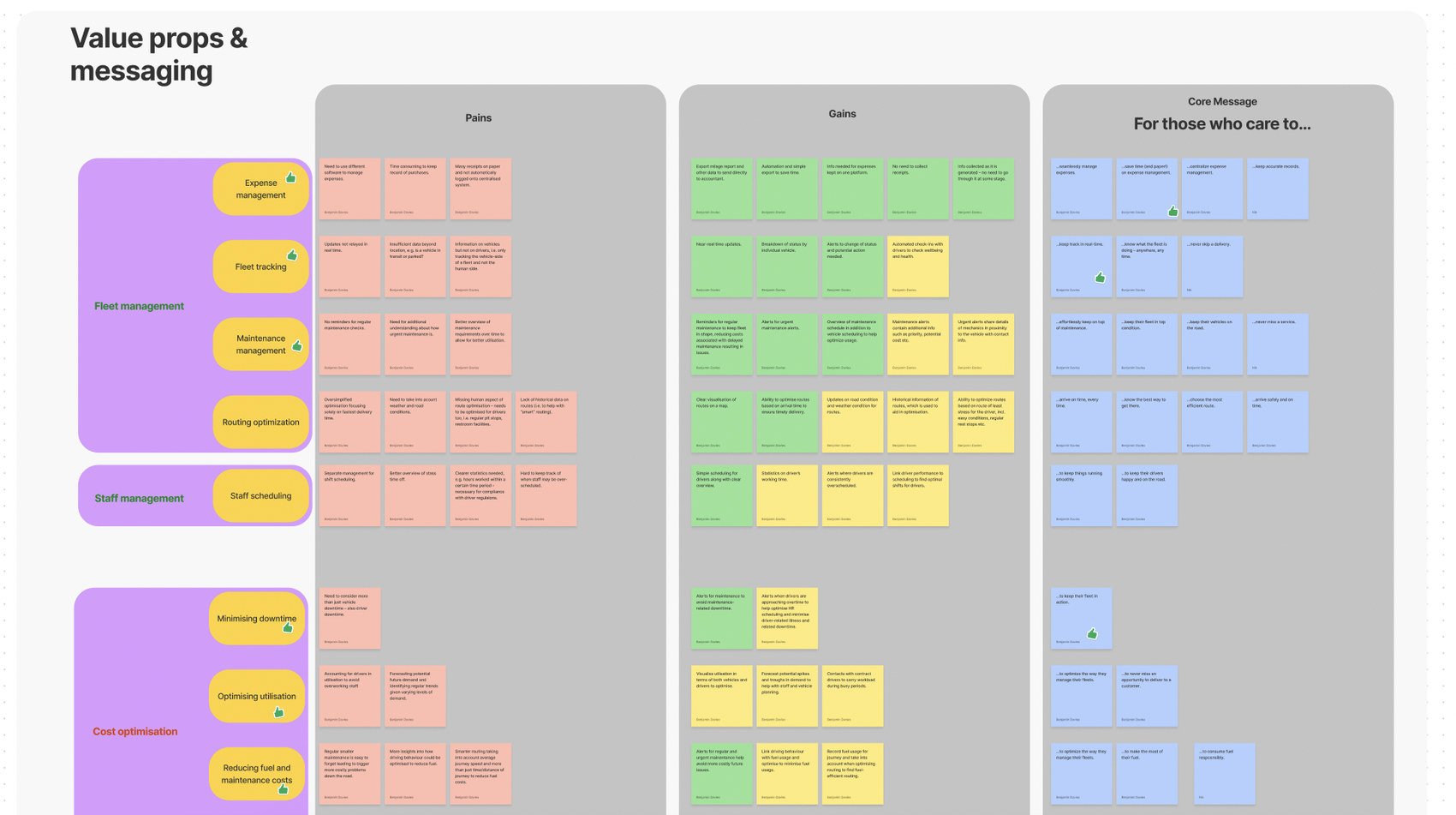
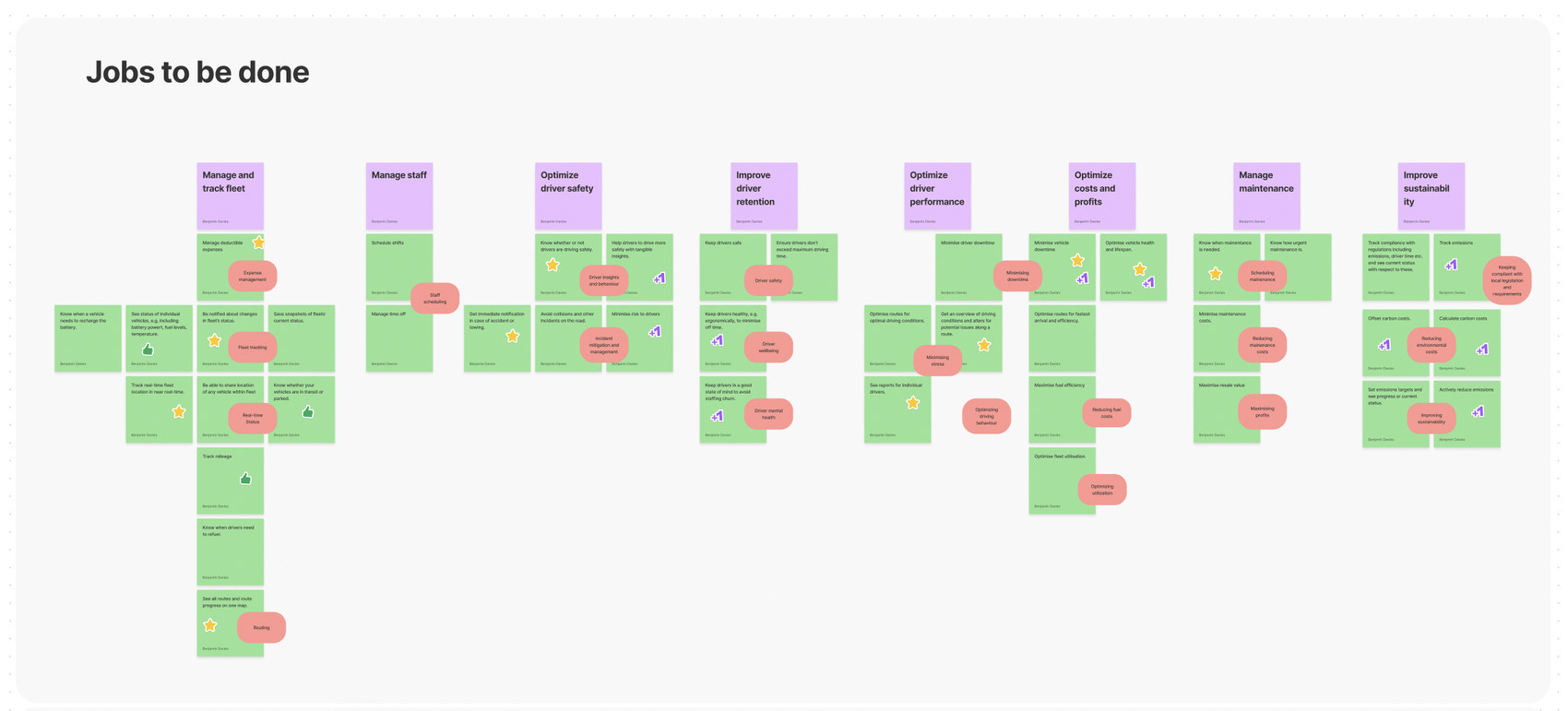
The re-usable messaging framework
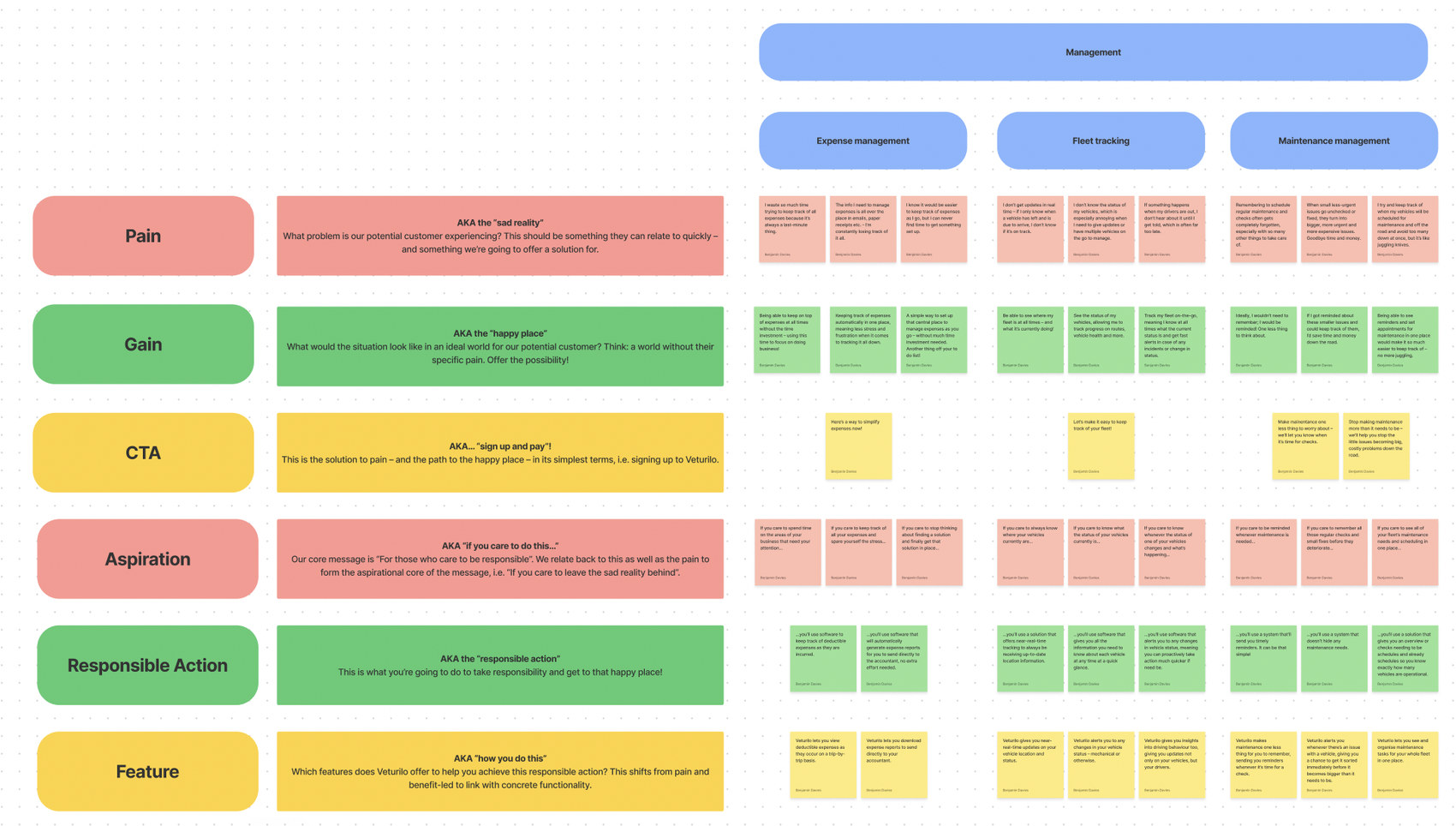
The workshop's real deliverable wasn't a tagline — it was a matrix the team could keep using long after I left the room. Six rows, each with a specific job:
- Pain — the "sad reality": a problem the customer will recognise immediately.
- Gain — the "happy place": what the world looks like with that pain solved.
- CTA — the "sign up and pay": the simplest possible path from pain to happy place.
- Aspiration — the "if you care to do this," tied back to Veturilo's core message: for those who care to be responsible.
- Responsible action — a more personal version of the CTA, framed as what a responsible person does next.
- Feature — the concrete functionality that makes the responsible action possible.
What it became
That bank of copy didn't stay a workshop artefact. It became the foundation for a full rebrand — the company now trades under a new name — and the basis for A/B testing across ad channels to find out which messaging pillars actually converted best in the wild. The framework structure meant that testing wasn't a guessing game either: every variant traced back to a specific pain, gain, or persona, so a winning ad told the team something reusable, not just a lucky headline.