Renaming a product suite after an acquisition
24 senior stakeholders, three weeks before the press release, and a company with no naming process at all. Here's how HERO became Virtual Shopping — and the template Klarna still uses to name things.
The situation
In 2021, one of my consulting clients, HERO, was acquired by Klarna. As part of the deal, HERO's entire product suite needed new names to sit inside Klarna's broader portfolio — an umbrella name, plus names for every platform and feature underneath it. The complication: Klarna had no central naming process. Every previous naming decision had happened ad hoc, which meant this one was starting from zero, under a press deadline.
I led a cross-functional team of designers and product marketers, designed the process from scratch, and managed 24 senior stakeholders across both companies through it in three weeks.
Stakeholder-proofing the process
Twenty-four directors and C-levels across design, product, and marketing, all directly invested in the acquisition's success, all with opinions. (They affectionately became known as the Council of Elrond.) The obvious failure mode was opening the floor to name suggestions directly — that turns into an argument about taste, and taste doesn't scale to 24 people.
So instead of asking "what should we call it," I got agreement first on how we'd judge whether a name was right. With a Senior Design Lead and a Product Marketing Director, I ran the group through a staged process, with a standing check-in every two days to review output and get sign-off before moving on:
- Context mapping — every touchpoint a user might encounter the name in, from press releases to in-app notifications, gathered up front so "does it work in a tweet" stopped being an abstract argument.
- Benchmarking — a shared view of which competitor names the group already rated, and why.
- Naming criteria — written as acceptance criteria with a scoring rubric, so a debate became "X scores a 2 on existing mental model alignment, Y scores a 3" instead of a fight about preference.
- Long-listing — stakeholders contributed candidates, scored against the criteria, narrowed to five.
- User testing — interviews with five of our biggest merchant partners on mock-ups of all five candidates, including sentiment analysis — international partners were especially useful on how well each name would localise.
- The decision — a secret ballot, with the Domain Lead and CEO holding final say.
Templating the process
Klarna didn't have a naming process before this project — it does now. I refined the FigJam board I'd built into a reusable template, and other teams across the company have used it since, including when I led the naming of Shoppable Video, a new domain within Klarna's Social Shopping product.
Teams who've picked it up consistently point to the user testing stage as the most valuable part — grounding a naming decision in real sentiment, rather than internal opinion, is what makes the final call defensible.
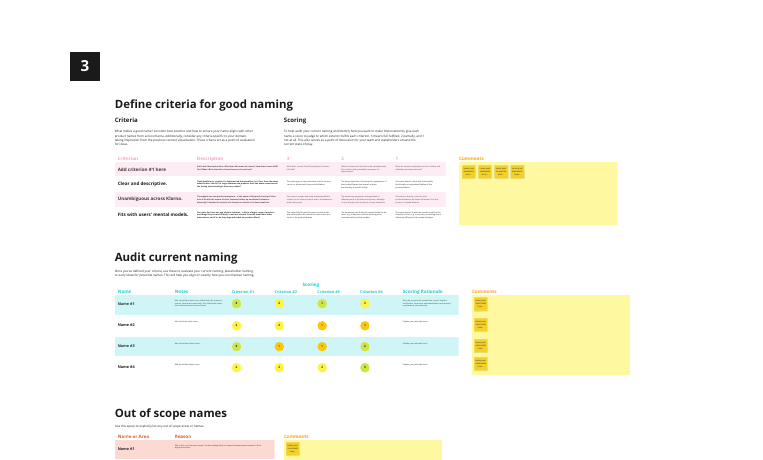
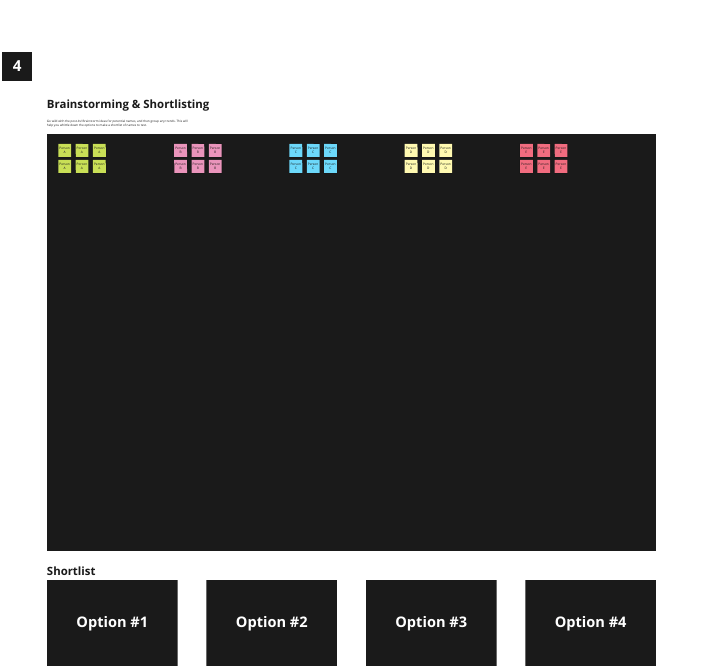
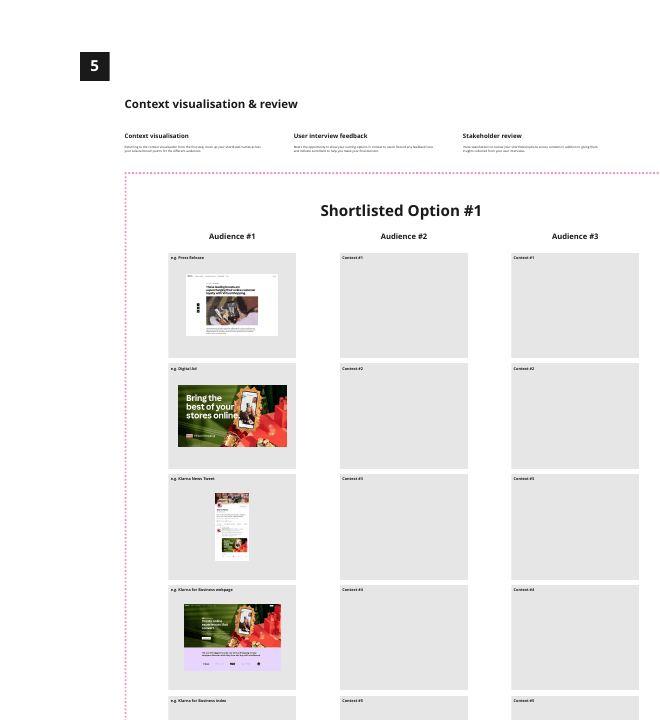
Shown here as the blanked reusable template rather than the original HERO/Klarna data, which stays confidential.
Rolling it out — and the number that mattered
Every stakeholder sent me the touchpoints from their area, and I wrote messaging guidelines for how Virtual Shopping should appear in each one. Marketing had already built a landing page before the guidelines existed — competent, but leading with the name itself rather than the value behind it.
Once the guidelines were in place, I proposed a second version that led with the value proposition and used the new name as an anchor rather than the headline. That version drove a 57% increase in click-throughs to the Virtual Shopping demo — the clearest evidence in the whole project that a good name still needs the right words around it to do its job.